- Instructor: Kim Le Robertson
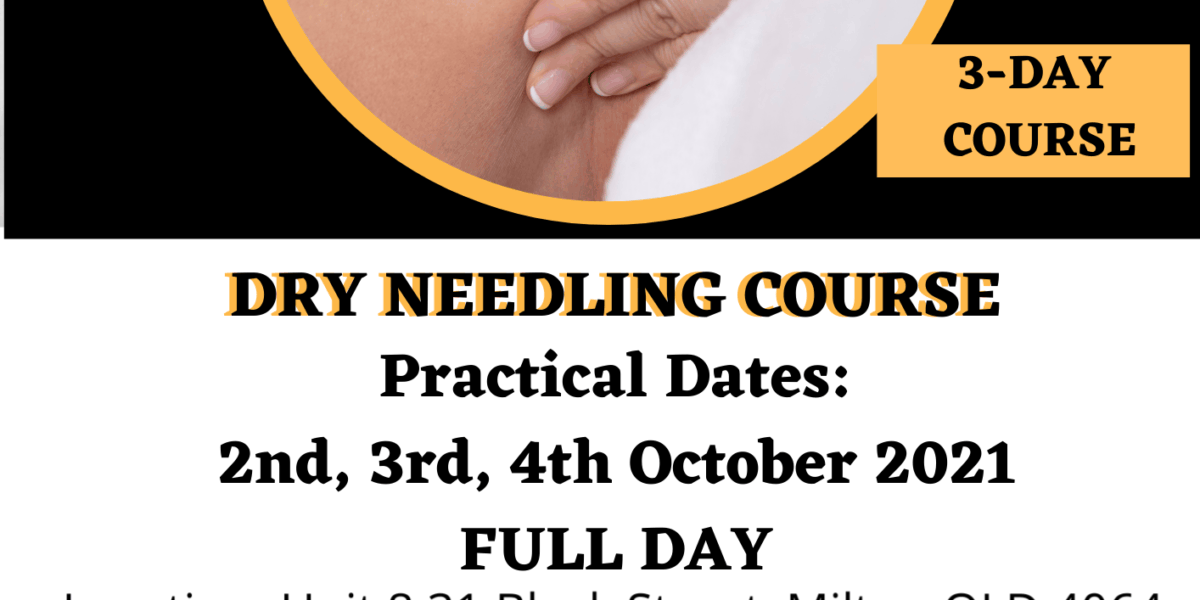
- Duration: 3 days
What is Myofascial Dry Needling?
Dry needling is a technique physical therapist, my remedial massage therapists use for the treatment of pain and movement impairments. The technique uses a “dry” needle, one without medication or injection, inserted through the skin into areas of the muscle.
Trigger Point Dry Needling (TDN) is the treatment that use very thin needle insert through skin and push into muscle to treat myofascial trigger point pain.
Difference between acupuncture and dry needling:
Acupuncture is form of Chinese alternative medicine which involve the insertion of thin needles through your skin at strategic points follow energy meridian line restore balance and help treat health condition by opening up the person’s energy flow or Chi
Dry needling: dry needling practitioners inserting a needle directly into a myofascial trigger point will release tension in the surrounding muscles for therapeutic purposes
What is trigger point?
Myofascial trigger point is defined as muscle knot
What is active and inactive/ latent trigger points?
- Active TrP is any point that causes tenderness and referral pain pattern on palpation. Almost always central TrPs are active and some satellite TrPs are also active (but not necessarily all of them). Inactive TrPs can eventually become active if there is a provocative factor.
- Inactive or Latent TrPs can develop in anywhere and under fingertips feel like lumps, but are not painful. Can increase a stiffness of the muscles.
Symptom of Myofascial Trigger Points
- Dull ache,
- Deep, arching in the muscle
- Stabbing pain,
- Burning,
- Referred pain
- A tender knot in a muscle
What can Myofascial Dry Needling help with?
Some common reasons and symptoms that can benefit from dry needling
- Back Pain
- Neck pain
- Headaches
- Strains
- Scar tissue
- Sciatica
- Chronic Pain
- Muscle Spasms, presence of painful knots in muscles that when pressed produce intense localized or referred pain
- Mood or sleep disturbances
- Musculoskeletal Diseases
- Occupational myalgias
- Post-traumatic hyperirritability syndrome
- Joint dysfunction (osteoarthritis)
- Tendonitis and bursitis
- Neurological Disorders
- Trigeminal neuralgia
- Glossopharyngeal neuralgia
- Sphenopalatine neuralgia
- Systemic Diseases
- Systemic lupus erythematosus (SLE)
- Rheumatoid arthritis
- Gout
- Psoriatic arthritis
- Infections (viral, bacterial, protozoan, parasitic and Candida albicans infection)
- Lyme Disease
- Hypoglycemia and Hypothyroidism
- Heterotopic Pain of Central Origin
- Axis II-Type Disorders
- Psychogenic pain
- Painful behaviours
Symptoms and Clinical Findings
- A patient with a chronic pain (ex: headaches, aches everywhere, morning stiffness, TMJ syndrome, tinnitus…), which, in reality, is often physically away from the active trigger point.
- Muscle weakness or imbalance, altered motor recruitment, in either the affected muscle or in functionally related muscles.
- Changes in Range of Motion (ROM).
- Painful movement
- accompanying symptoms, such as tension headaches, migraines, tinnitus, temporomandibular joint problems
- Postural abnormalities and compensation
Benefits of Myofascial Dry Needling
- Release myofascial trigger point
- Release pain and stiffness
- Enhance movement and function
- Improve rehabilitation
Why Practitioner should learn Myofascial Dry Needling now?
- You’ll be able to treat more conditions and have more options for treating the same conditions that you treat now. You’ll have more tools in your toolbox.
- It will increase the types of conditions that you will be able to treat.
- It will create new treatment opportunities and interventions that you never thought possible.
- You’ll retain more patients and you’ll get more referrals for Dry Needling therapy instead of having to refer patients to other practitioners.
- You’ll grow in confidence as a practitioner by learning this new skill.
- You’ll ALSO receive the very handy CPD Health Courses FREE Dry Video Training App which contains loads of great Dry Needling video clips to show & remind you of the important safety points, like needling directions, handling and referral patterns.
Course Recognition
Deliverables
- Introduction, history and current evidence-based medicine
- Safe practice
- Clinical application guideline 1 & 2
- Dry needling principles and concepts 1, 2, & 3
- Regional dry needle application
- Posterior spinal muscles
- Lower leg and foot muscles
- Posterior, anterior and medial thigh muscles
- Pectoral girdle, glenohumeral and upper limbs
- Hip and pelvis muscles
- Cervical spine muscles
- Practical clinical case studies and Complex clinical cases
- Assessments
What will you learn at our Dry Needling Introductory course?
Our Dry Needling Introductory course focuses on the treatment of myofascial trigger points in the most common muscles of the body. We’ll teach you how to needle the following;
Biceps Brachii, Biceps Femoris, Brachioradialis, Deltoid, Extensor Carpi Radialis Brevis/Longus, Extensor Carpi Ulnaris, Extensor Digitorum, Gastrocnemius, Gluteus Maximus, Gluteus Medius, Gluteus Minimus, Gracilis, ITB, Multifidi, Palmaris Longus, Peroneus Brevis/Longus, Rectus Femoris, Sartorius, Semimembranosus, Semitendinosus, Soleus, Tibialis Anterior, Triceps Brachii, Upper Trapezius, Vastus Lateralis & Vastus Medialis.
Course Structure:
There are 2 parts to our Dry Needling Introductory course, the 8 hr online theory program and the 12 hr practical course (Fri 5-8pm, Sat 8-6pm).
Dry Needling Introductory Practical Course: 12-hours
- Having completed your online theory program, you’re ready to attend the Dry Needling Introductory practical training at a location of your choice. This is a purely practical course which covers needling techniques for muscles in the following regions:
- Posterior Surface of the Forearm
- Upper Arm
- Upper Trapezius
- Anterior Thigh
- Medial & Lateral Thigh
- Posterior Thigh
- Antero-lateral Lower Leg
- Posterior Lower Leg
- Buttock
- Low Back
Dry Needling Introductory Theory Course: 8-hours
Our comprehensive online program guides you through the following areas of study:
- Module 1: Introduction & Benefits of Dry Needling
- Module 2: The History & Background of Dry Needling
- Module 3: The Neurophysiology of Dry Needling
- Module 4: Myofascial Trigger Points
- Module 5: Safety & Risk Management
- Module 6: Needling Techniques
Course outline:
This course aims to provide qualified Remedial Massage Therapists the necessary Dry Needling skillset to apply to clients with Myofascial trigger point conditions.
Both practical and theoretical sessions will be delivered including the below
Modules:
1. Introduction, history and current evidence based medicine
2. Safe practice
3. Clinical application guideline 1 & 2
4. Dry needling principles and concepts 1, 2, & 3
5. Regional dry needle application: Posterior spinal muscles; Lower leg and foot muscles; Posterior, anterior and medial thigh muscles; Pectoral girdle, glenohumeral and upper limbs; Hip and pelvis muscles; Cervical spine muscles
6. Practical clinical case studies and Complex clinical cases
Entry level
Our requirement of education is study of physiology, osteopathy, chiropractic, myotherapy, nursing, podiatry or occupational therapy, because of presumed anatomy, advanced palpation skills and the structure of these courses
Duration
80 Hours
What to bring
- 3 large-sized towels and 2 small-sized towels
- Your lunch
- Tea and coffee will be provided throughout the course
What to wear
Comfy outfits and short nails
Course fee
Price: $1350
Location
08/31 Black Street, Milton, Queensland, 4064
